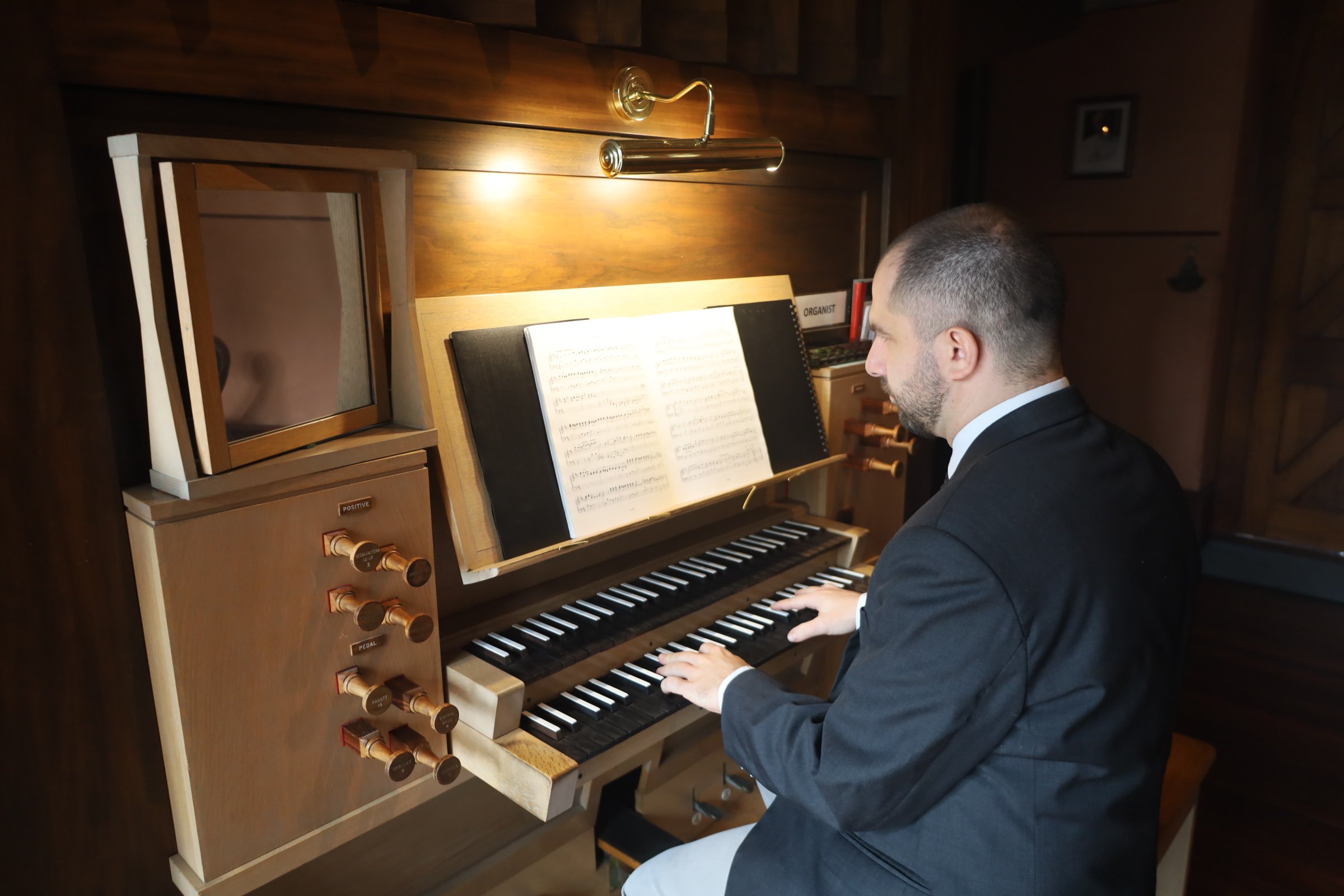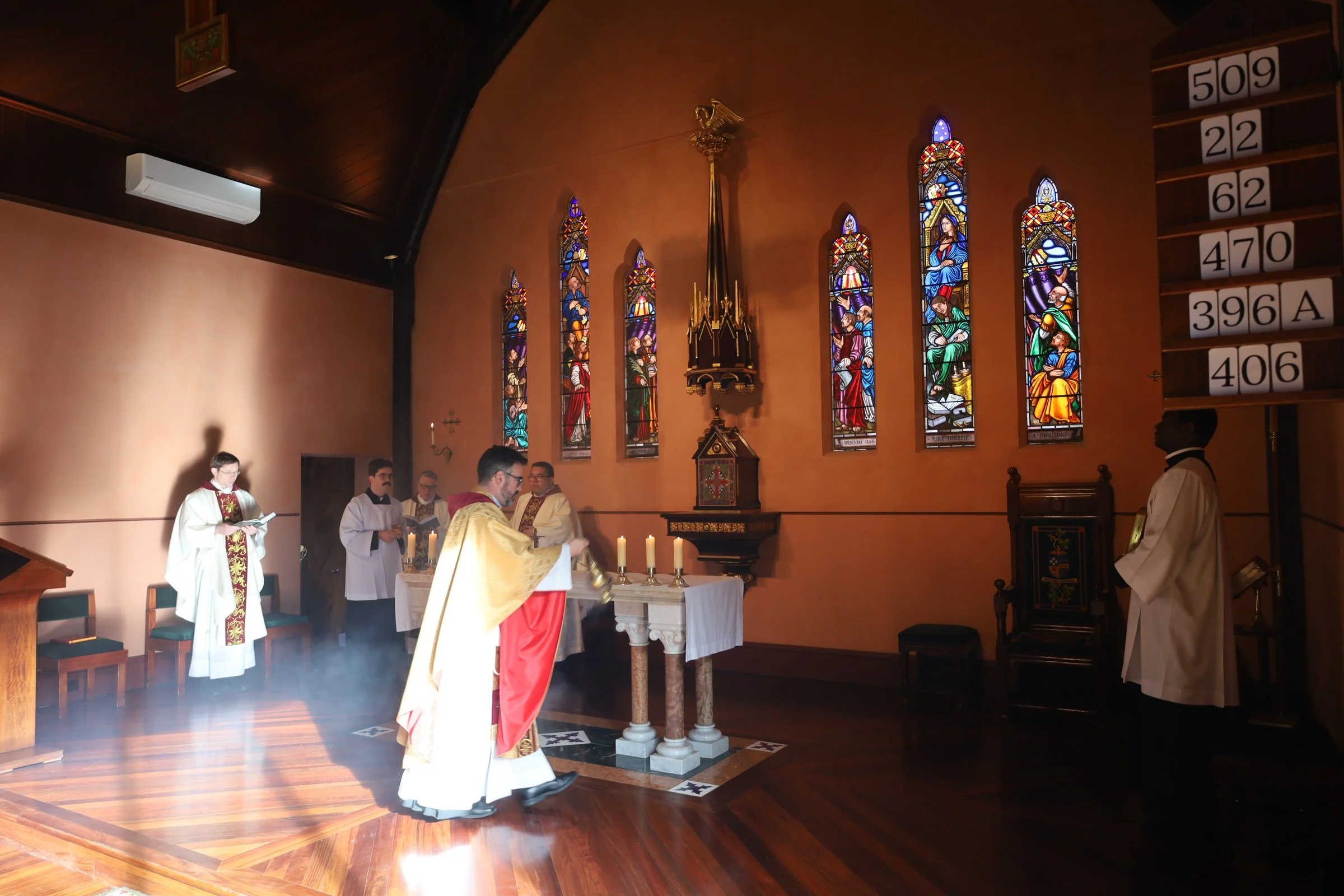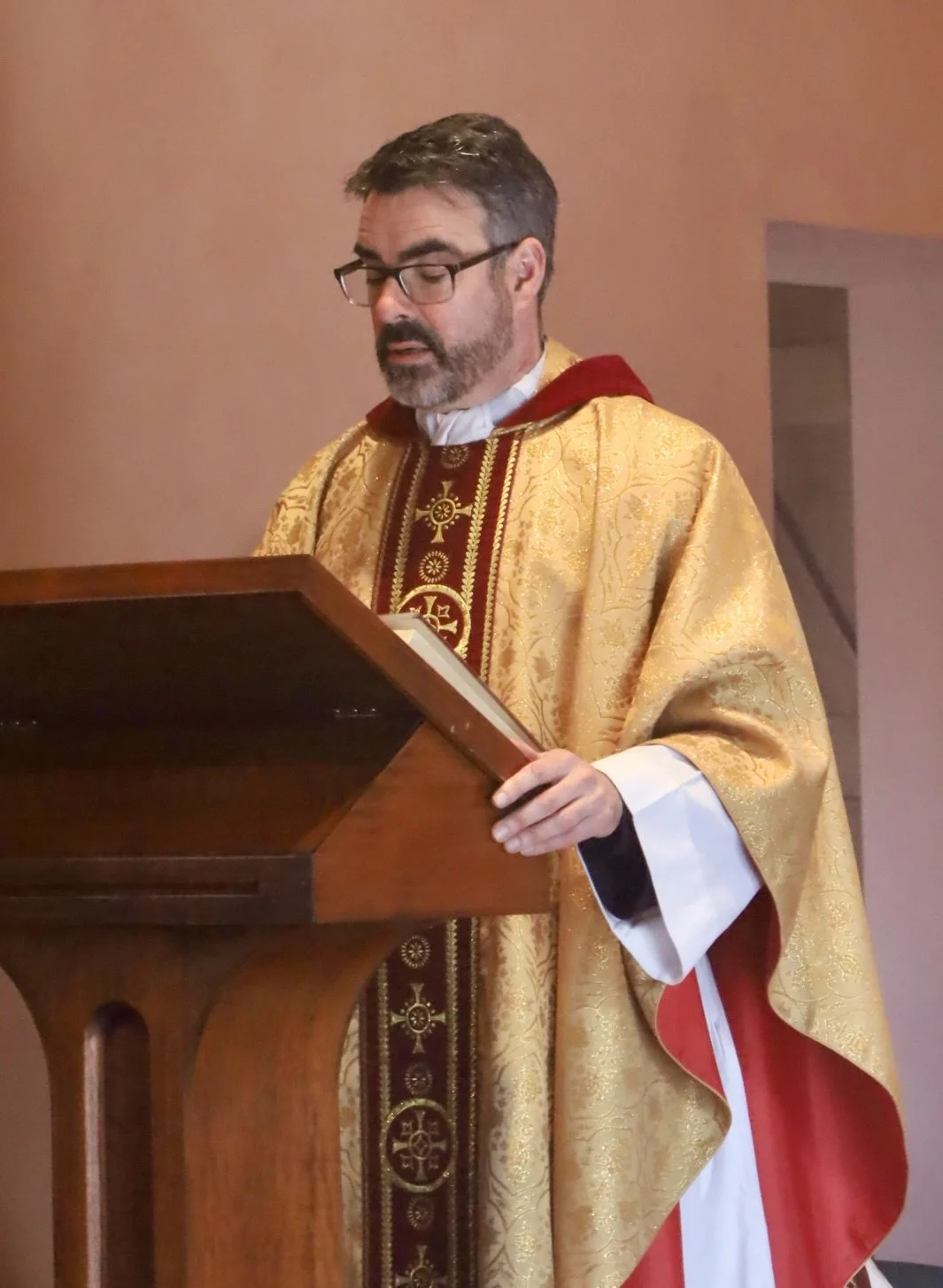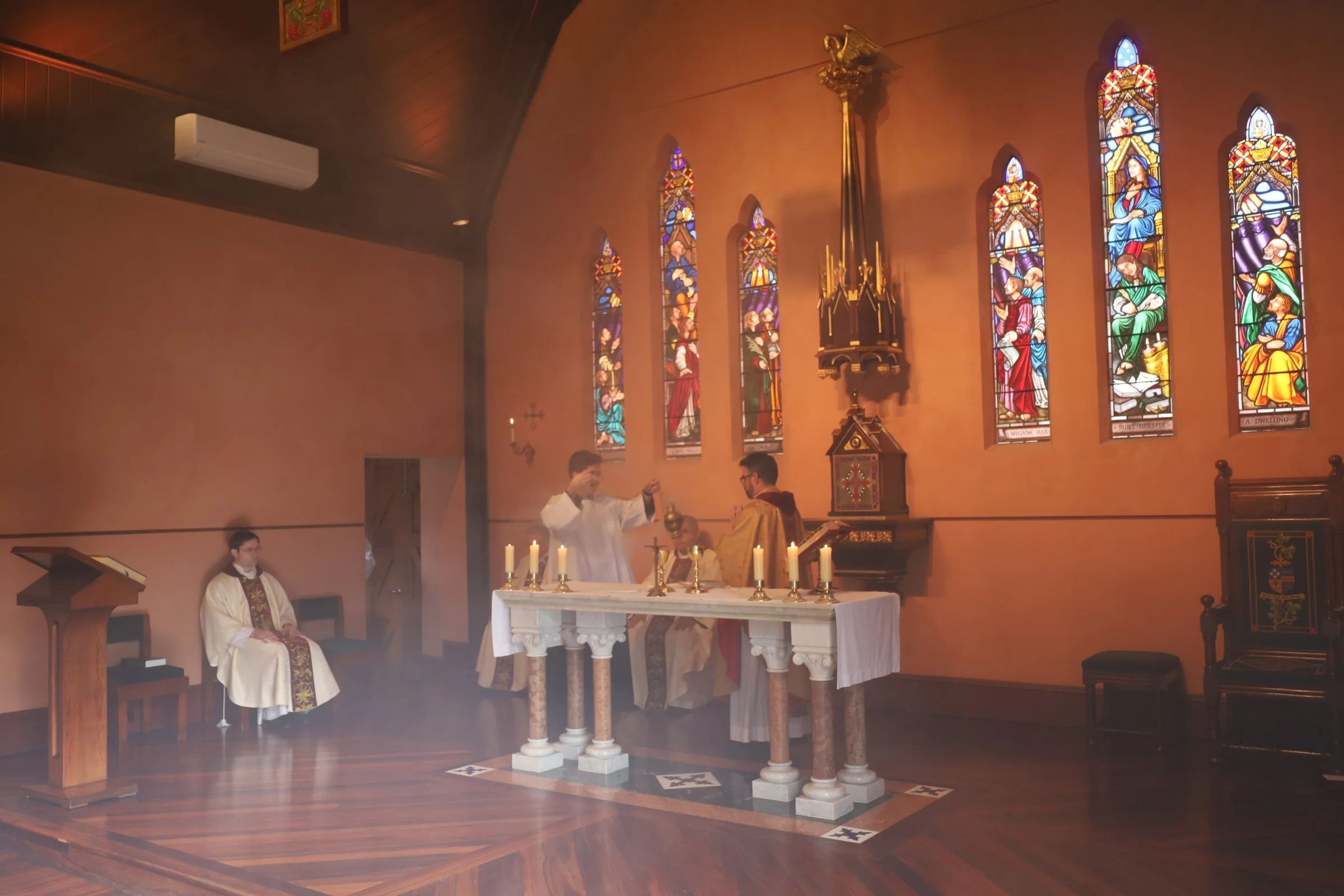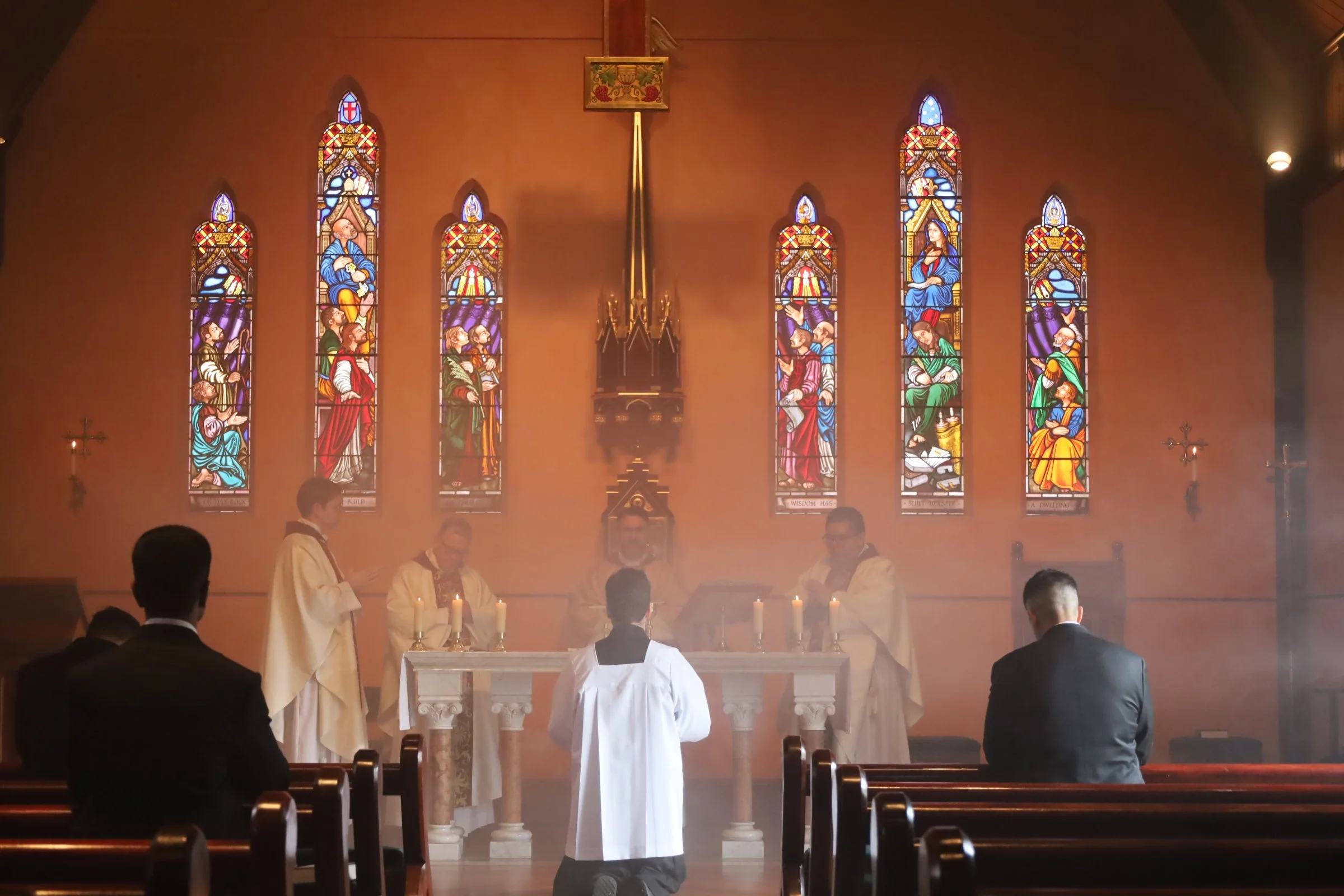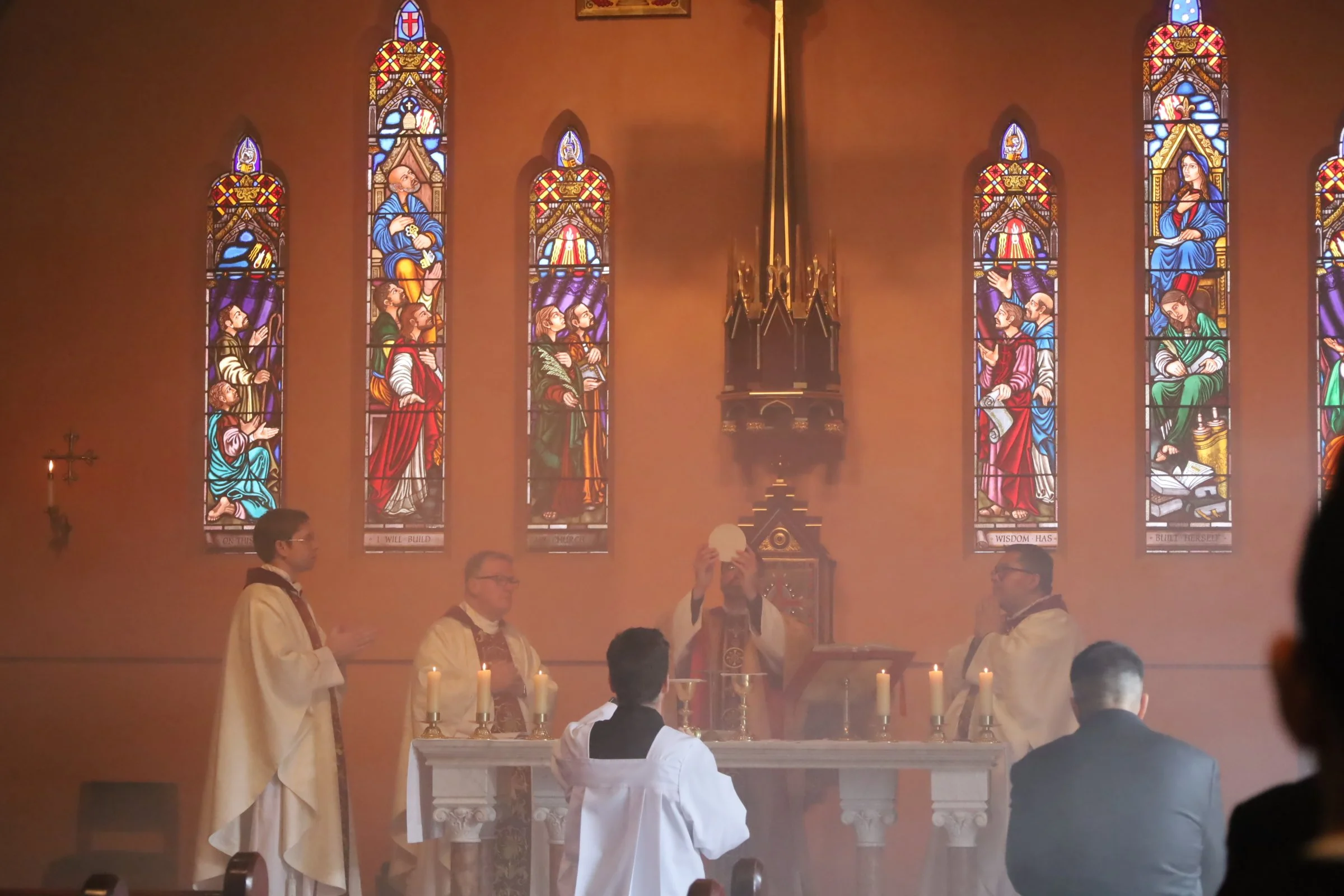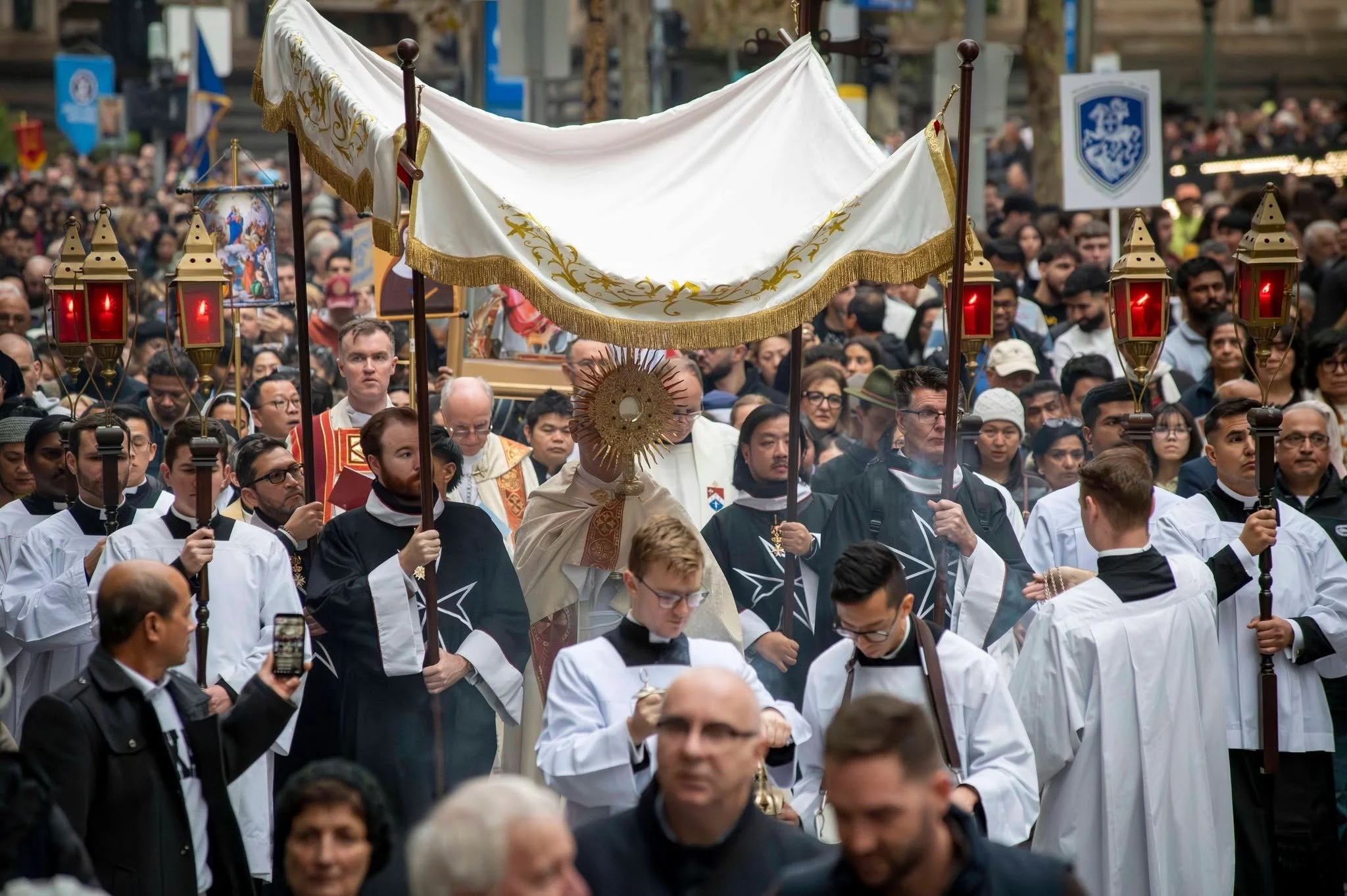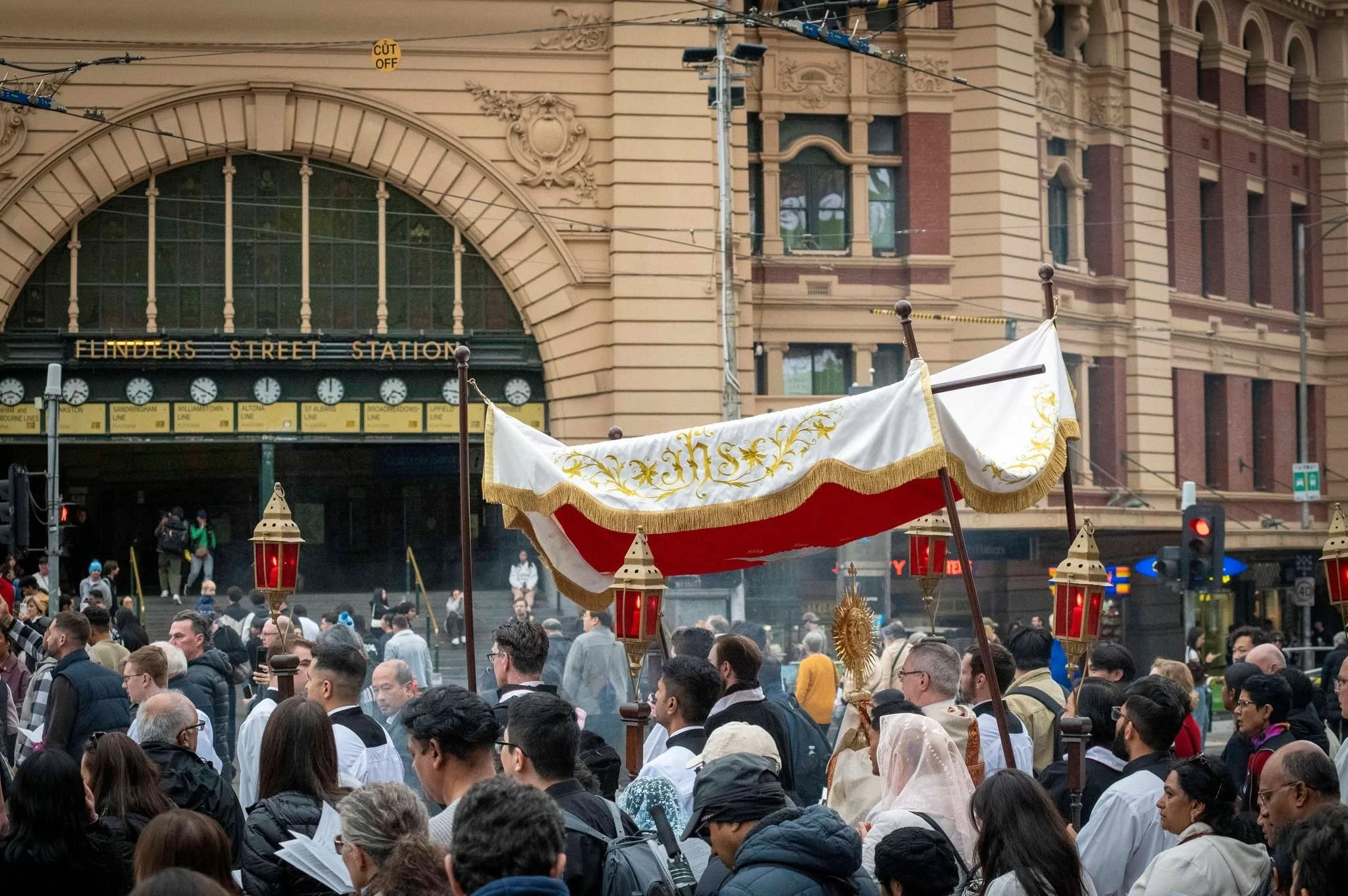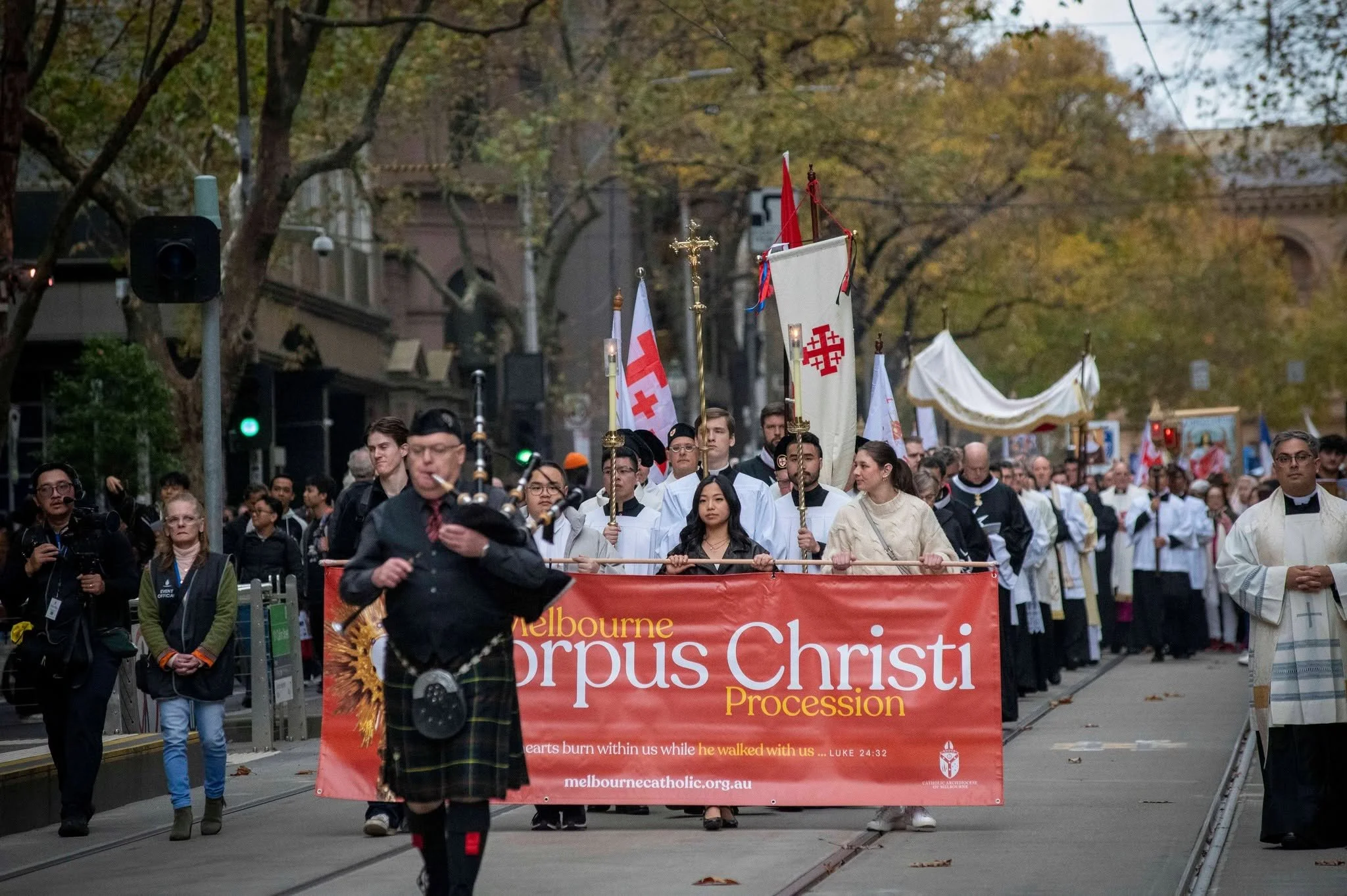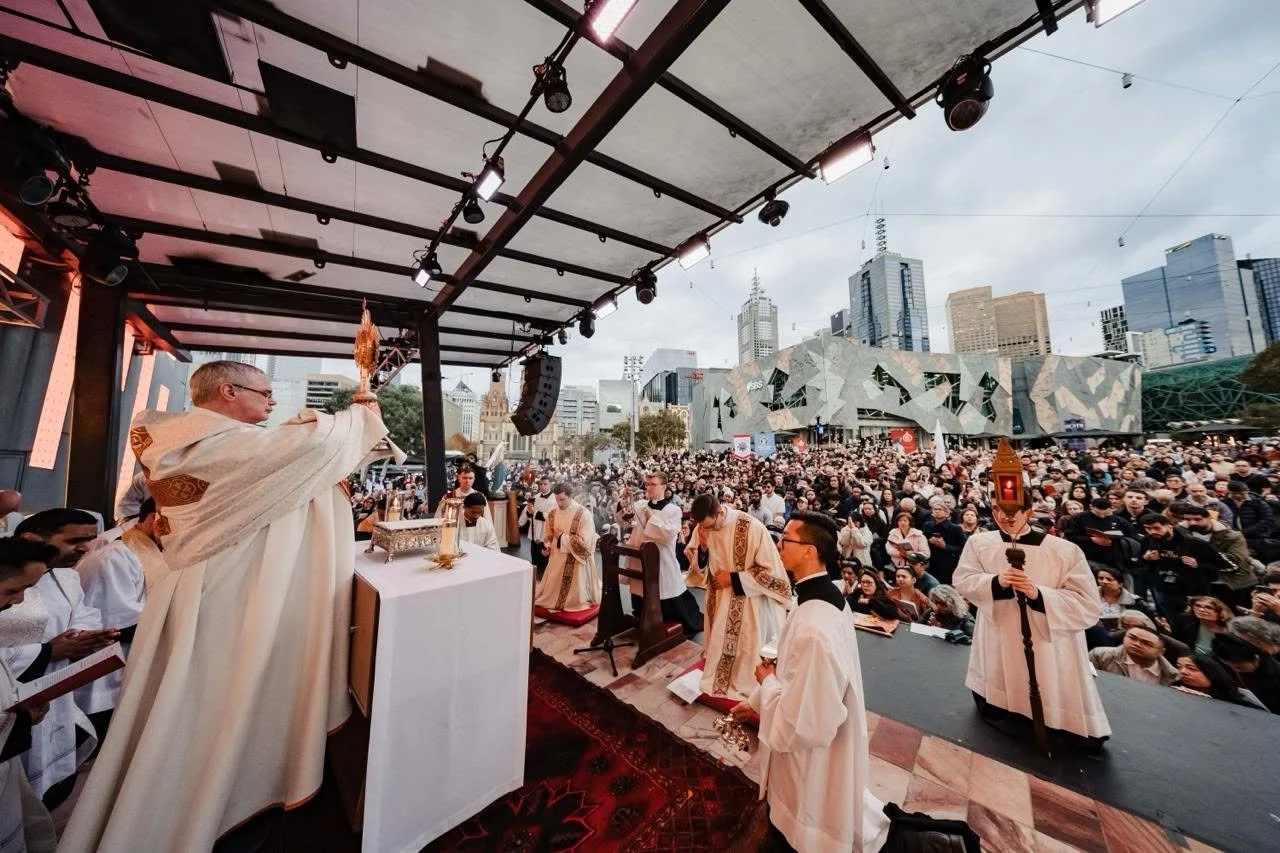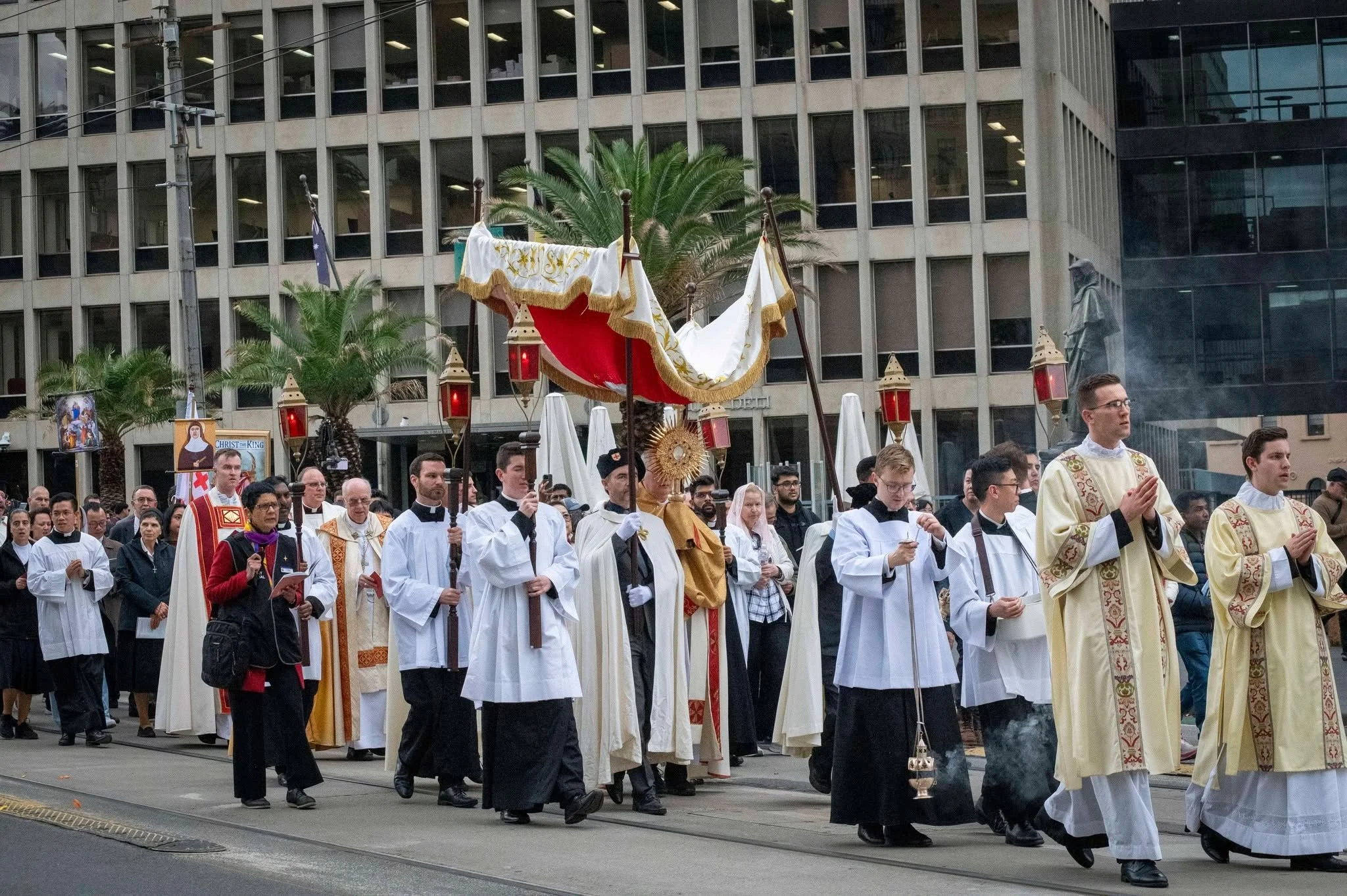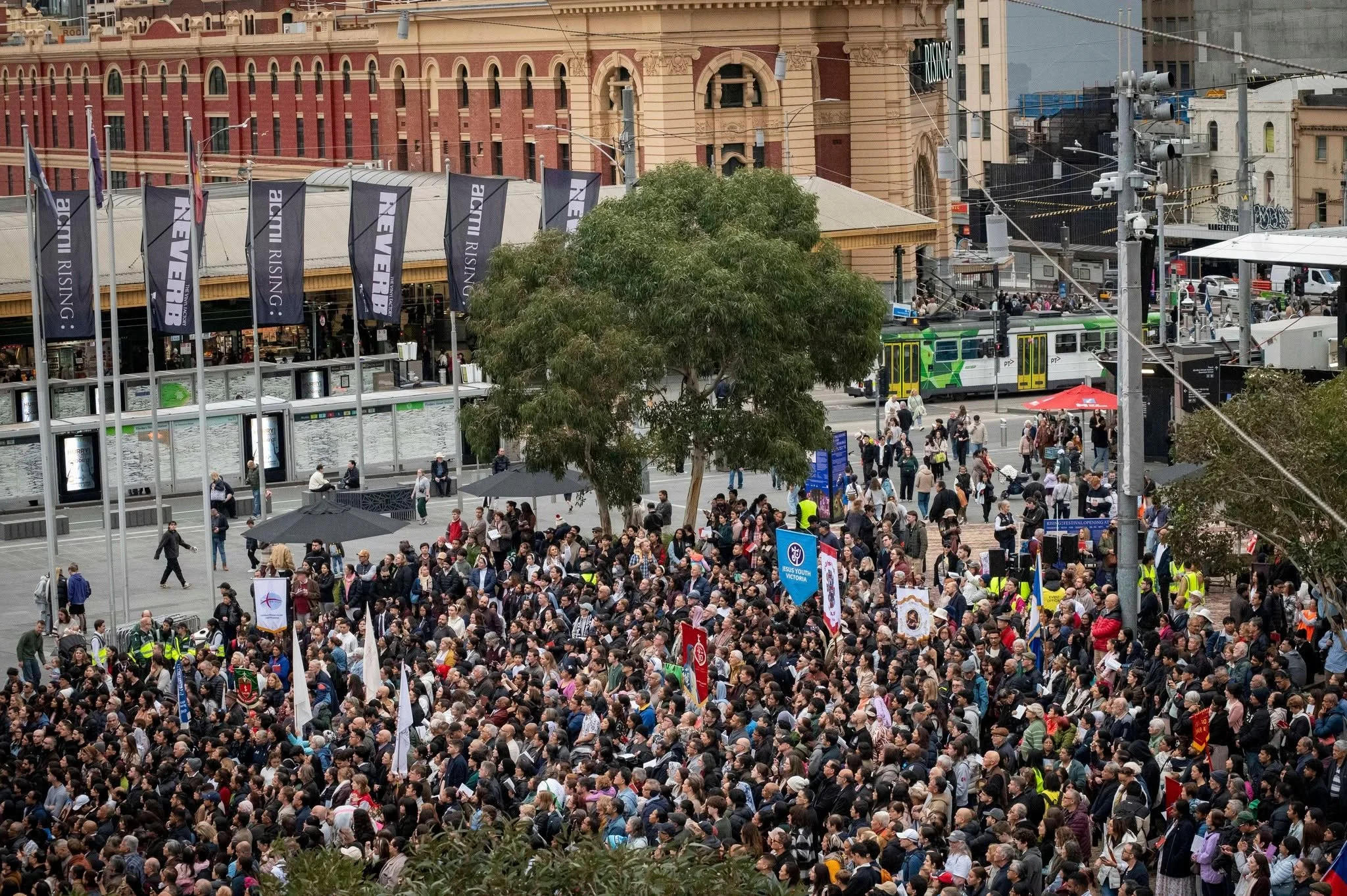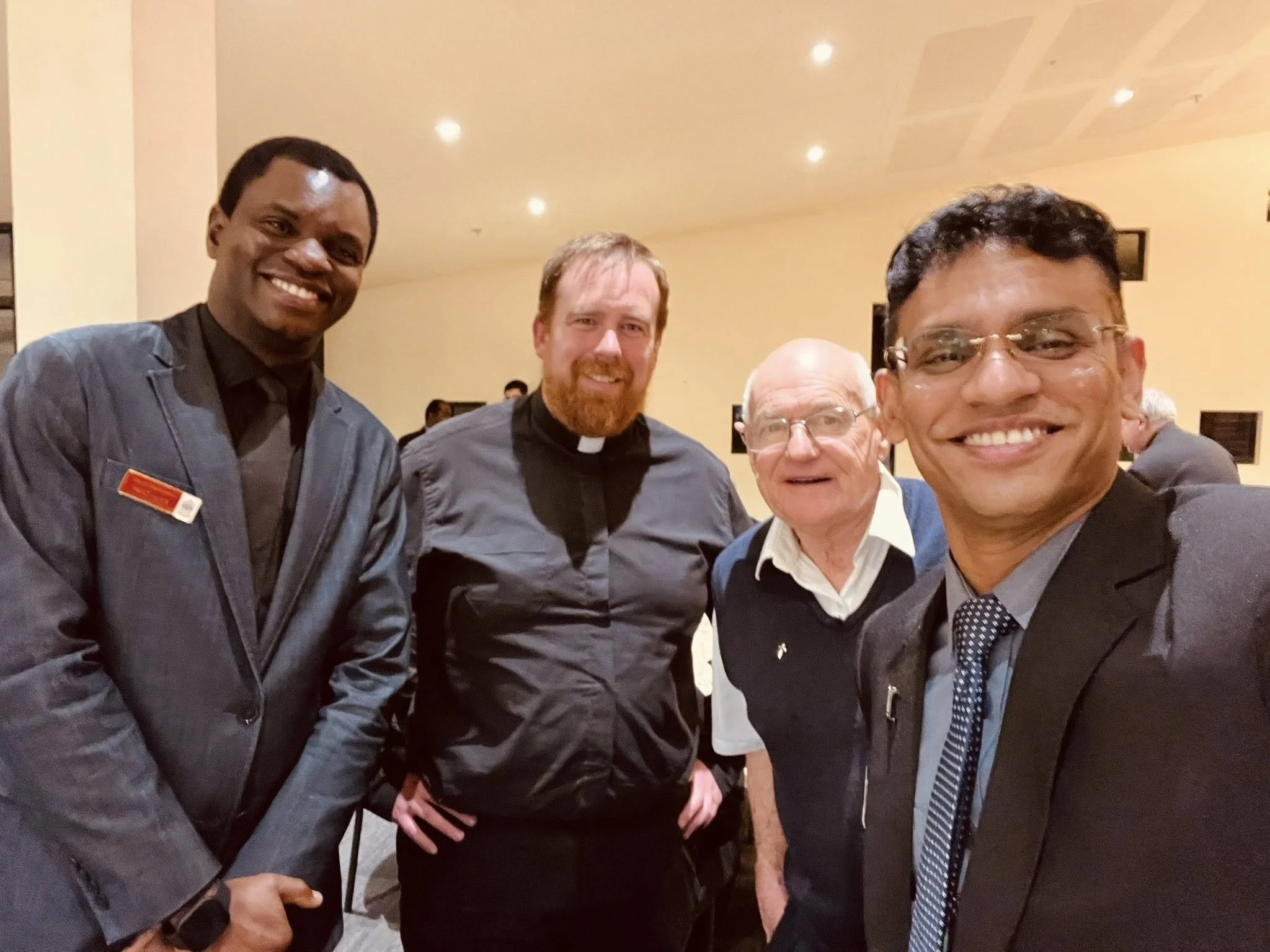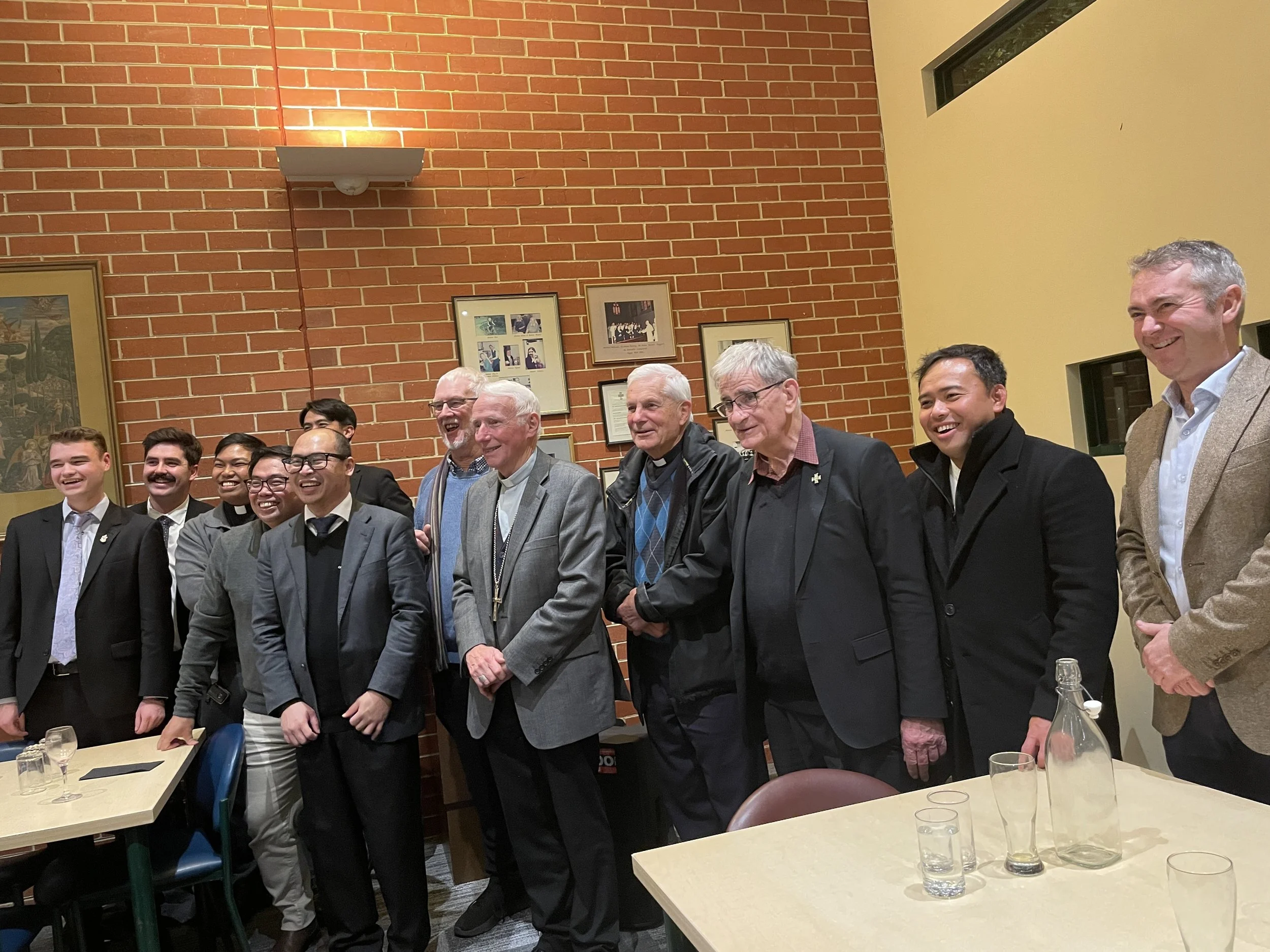
On Sunday 7 June 2026, we celebrated our Patronal Feast. To mark the Solemnity of the Most Holy Body and Blood of Christ (Corpus Christi), we celebrated Solemn Mass in the Seminary Chapel. The principal celebrant was our Rector, Fr Cameron Forbes, whose homily to the community can be read below. In the afternoon, many of the seminarians assisted with the Corpus Christi Procession from St Patrick’s Cathedral to Federation Square. We concluded the festivities by hosting our annual Clergy Dinner for alumni and the priests of the province.
Homily
Very Rev. Dr. Cameron Forbes
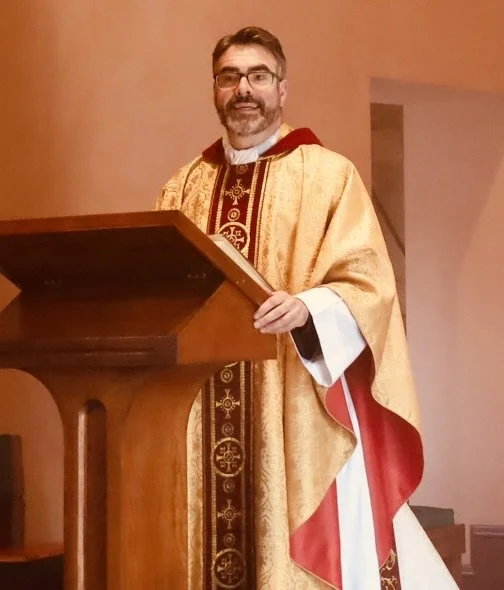
The founding of our seminary is somewhat enshrouded in the mists of time. Very little archival material still exists from the early years. I can confirm that in 1926 the trustees gave the rector the authority to buy the fruit and vegetables himself, a practice which seems, in the words of the canonists, to have fallen into desuetude. However, to paraphrase that funny little note in the credits at the end of every film, “all rights remain reserved”.
“Of all our daily activities, it is the Eucharist that most shapes us into men of Christ serving the Body of Christ.”
How did our seminary come about? What we can know for sure is that in 1922, the Australian bishops decided that rather than insisting on a national seminary, each diocese could make its own training arrangements for seminarians. After this decision, Archbishop Mannix acted very quickly indeed. Within a few weeks he had purchased Chirnside Park, Werribee, and announced that the new seminary would open in March 1923. The Victorian country bishops supported the move, and the Archbishop of Hobart was soon to follow. Nine students arrived that following March on the feast of St Joseph.
A seminary always has a name. We believe that the name Corpus Christi College was chosen by Archbishop Mannix, but nothing more is really known. The crest came later, and, as we know, the motto “De Te Vivere” was chosen from St Thomas Aquinas’ famous hymn, Adoro Te Devote.
It is entirely appropriate that Corpus Christi College – a seminary named after the Body of Christ – was founded to train priests – in persona Christi – to nourish the Body of Christ, Christ’s faithful people who serve the world with love and sacrifice.
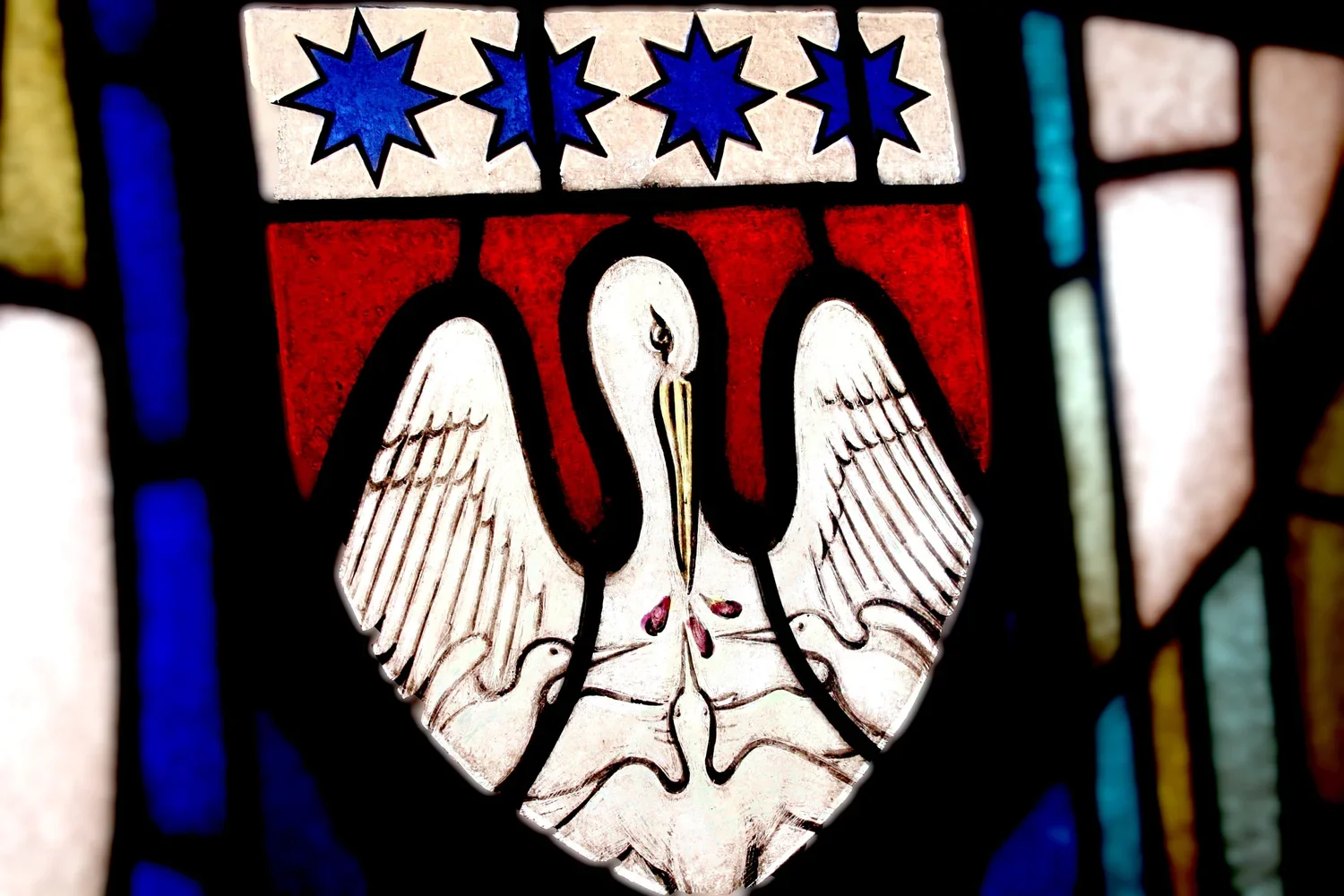
Although the College crest was designed sometime later, its significance is still important. “The Pelican in her Piety”, as it is called, is a medieval Christian symbol which depicts a mother pelican wounding her own breast to feed her starving chicks with her blood.
Because the mother pelican nourishes her children with her own body and blood, early Christians adopted this bird as a metaphor for Jesus sacrificing himself on the cross to save humanity. And so we can frequently find the "Pelican in her Piety" carved into altars, painted in medieval manuscripts, and crafted into stained-glass windows.
And what of the feast we celebrate today? The universal church has celebrated it since the year 1264. The Pope at the time, Urban IV, commissioned St Thomas Aquinas to write the official liturgy and hymns for the feast day. We think particularly of the hymns Pange Lingua, used on Holy Thursday, and Tantum Ergo, used for Eucharistic Adoration. The hymn most closely associated with our own seminary, Adore Te Devote, is actually believed to have been written by St Thomas for his own private use in daily Eucharistic devotion. Thankfully, its usage has grown much wider. I find it very moving each year, when attending the Mass of Jubilarians from Corpus Christi College, to hear them singing this hymn in Latin from memory.
Of all our daily activities, it is the Eucharist that most shapes us into men of Christ serving the Body of Christ. I was reminded of this when reading the new encyclical of Pope Leo, Magnifica Humanitas. He concludes by emphasing the importance of the Eucharist. The “Amen” we say in the liturgy, he writes, “the Body we eat and the Blood we drink shape our entire lives. The Eucharist is an extremely personal encounter with the Lord and yet never simply an act of individual piety. In the Eucharist we find a visible manifestation of the reality that we are the Church of Christ, his members, his body. We are brothers and sisters in him. And in Christ, though many and diverse, we are one: In Illo uno unum.” These words are the Pope’s own motto, “In the One, we are one.”
I grew up using the phrase “to take communion”, and this usage is credible when we remember that Jesus directed his disciples to “take” his body and the cup of his blood. However, how much deeper it is to say that we are receiving communion, which emphasises that Communion is a gift from Christ.
In the words of Pope Benedict, “the words ‘to receive communion’, are beautiful and very eloquent. In fact, when we do this act we enter into communion with the very life of Jesus, into the dynamism of this life which is given to us and for us. From God, through Jesus, to us: a unique communion is transmitted through the Blessed Eucharist.”
Pope Benedict writes that “the Eucharist is not a meal among friends. It is a mystery of covenant.” And he quotes the great saint Edith Stein, who writes that "The prayers and the rites of the Eucharistic sacrifice make the whole history of salvation revive ceaselessly before the eyes of our soul, in the course of the liturgical cycle, and make us penetrate ever more its significance”. He continues: “We are called to enter into this mystery of covenant by conforming our life increasingly every day to the gift received in the Eucharist. It has a sacred character, as Vatican Council II reminds: "Every liturgical celebration, because it is an action of Christ the priest and of His Body which is the Church, is a sacred action surpassing all others; no other action of the Church can equal its efficacy by the same title and to the same degree" (Sacrosanctum Concilium, No. 7).
This dynamism of the Eucharist is similarly described by St Augustine in his Confessions, where he speaks of a kind of vision he had, in which Jesus said to him: “I am the food of strong men; grow and you shall feed on me; nor shall you change me, like the food of your flesh into yourself, but you shall be changed into my likeness” (Confessions, vii, 10, 18).
I earlier quoted Pope Benedict saying that the Eucharist is not a meal among friends. We might consider this a caution against casualness. He is saying that it is important that we behold with sheer awe exactly what we are doing, that we must be always reverent and focused in our actions. This is because the Eucharist truly is the sacrifice of the cross, made accessible to us forever.However, it is true that the Eucharist is also a meal, in the sense that the sacrifice on the cross manifests itself today in sacred food and drink that makes friendship in faith with each other, a friendship which impels us to radical service and communal love.
It is this call to radical service which has drawn us to the priesthood. And so we train at Corpus Christi College, to be priests to serve God’s people, giving of ourselves, both as members of the Body of Christ, and to serve the Body of Christ in sacrifice and love. Today we give thanks for the work of our seminary, and pray that it may always flourish, that God’s people may be always well-nourished by those who study and minister here.