By Simon Zakari
Friday 17 April, 2026
Jn 6:1–15
Not long ago, I was on a crowded train during peak hour, a young mother stood holding her child while several passengers remained absorbed in their phones, avoiding eye contact and pretending not to notice her struggle. The scene is familiar in today’s world. People are physically close, yet emotionally distant; surrounded by others, yet often inattentive to their needs. After some time, one man finally looked up, rose from his seat, and offered it to her. It was a small and ordinary act, almost unnoticed by the rest of the carriage, yet it conveys a deep truth. Compassion often begins the moment we truly learn to notice. In a culture that can easily make us distracted and self-focused, the ability to recognise another person’s need is already an act of love.
This experience launches into today’s Gospel. Before the crowd asks, Jesus already sees their hunger. He notices their physical need and refuses to remain indifferent. His first instinct is not dismissal, but compassion. He asks Philip where bread can be found, not because he lacks the power to provide, but to draw the disciples into the logic of pastoral care. Jesus is forming them to see what he sees: people in need are never a burden to avoid, but persons to be loved. The miracle of the loaves begins not simply with power, but with attentiveness, the loving gaze that recognises need before words are spoken.
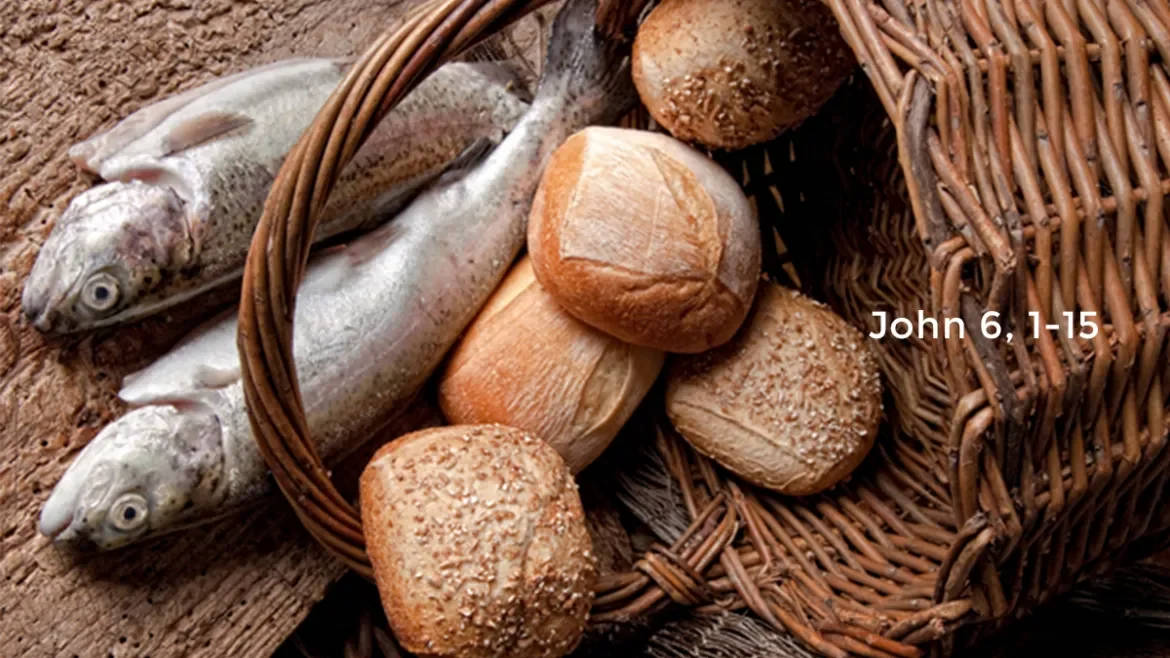
The Old Testament already foreshadows this divine sensitivity. In 2 Kings (cf. 4:42–44), Elisha fed one hundred men with twenty barley loaves. He refuses the servant’s logic of scarcity and instead trusts in the abundance of God’s providence. Twenty barley loaves seem insufficient for a hundred men, yet what is offered in faith becomes enough for all, with some left over. In John’s Gospel, Jesus brings this pattern to fulfilment. A boy’s five loaves and two fish, offered generously, become abundance in the hands of Christ. The miracle reveals Jesus as the new Moses, feeding God’s people in the wilderness, and it points beyond itself to the greater gift of the Eucharist, where Christ will not merely give bread, but give himself as Bread.
For us seminarians in formation, there is a particular urgency. Seminary life can easily become centered on lectures, writing essays, liturgy, and pastoral placements. While these are all essential dimensions of formation, authentic growth is often found in the small yet significant moments of daily brotherliness. We may notice a fellow seminarian exhausted and weighed down by fatigue, another quietly struggling to complete an essay, or a brother absent from meals because of illness. Such moments call for more than mere observation; they call us to compassionate action. In those instances, we are invited to ask ourselves: What would Jesus do in such situation? Often, it is the simplest acts of kindness, a word of encouragement, practical assistance, or a quiet gesture of care, that become most formative. In a world that frequently trains people to think first of themselves, seminary formation must shape us into men who are attentive to the unspoken needs of others and ready to respond with quiet generosity.
Priestly ministry, therefore, begins not only at the altar, but in learning to recognise hunger in all its forms; physical, emotional, spiritual, and pastoral. Jesus teaches us that before anything else, we must first be the compassionate gaze that sees human need. As priests in training, we must learn to notice the lonely parishioner, the struggling family, the poor, the young person searching for meaning, and the sick who long simply for presence.
The Eucharist deepens and perfects this formation. Christ not only gives bread; he becomes Bread. He feeds us with his own life so that we may become generous in ours. We are called to become like Christ, broken for the life of the world.